
Traffic Signal Design
Traffic Signal and PHB Warrant Analysis · Signal Design · Pedestrian Facilities
Traffic Signal and PHB Warrant Analysis
Traffic signal warrant analyses and evaluations are performed in accordance with the current MUTCD and, if applicable, any locality Supplement to the MUTCD. Factors which establish the basis of warrants for signalization include vehicular and pedestrian volumes, delays on side street approaches during the peak hours, lane use, crash history, speeds on the mainline approaches, and proximity to schools or rail crossings. Turning movement counts are collected including pedestrian and bicycle volumes for a minimum of twelve hours. The volume of side street right turns that experience little or no delay is also documented to aid in identifying whether a portion of right turns should be removed from the minor street volume considered in the volume warrants. A report is prepared to document the analysis and findings for each of the MUTCD warrants. In addition, for any warrants that are not met, thresholds are documented to identify how close the volumes may be to satisfying individual warrants. This indicates to the agency whether the intersection crash and volume trends should be monitored to determine if and when a signal may be warranted in the future. If signal warrants are not met, AMD Engineering recommends other remedial improvements that may be implemented in lieu of signalization to address any identified deficiencies.
Pedestrian Hybrid Beacon (PHB) warrant evaluations are performed based on the guidance provided in the current MUTCD and other industry standard policies. Factors which establish the basis of warrants for PHBs include the highest number of pedestrian crossings in an hour, major-street volumes corresponding to the same hour, roadway speeds, pedestrian crossing widths, walking speeds, the number of available gaps in the traffic stream, and crash histories. Proximity to adjacent signals and the ability to provide clear sight lines for pedestrians and motorists are also considered. Depending on the proximity to other traffic signals, a PHB, which typically operates on-demand, may not be the appropriate traffic control device. For example, more predictable operation (i.e., a traditional pedestrian signal) may be appropriate if the crossing location is close to another signal and on-demand operation of the PHB could cause blockages of the signalized intersection.
Engineering Design Services
Traffic Signal Design Services
Over the past 20+ years, AMD Engineering's principals have designed hundreds of traffic signals for agencies throughout Virginia, Maryland and Washington, DC. From the experience gained on projects ranging from small intersection modifications to large corridor-wide reconstructions, AMD Engineering understands the challenges facing municipalities when designing temporary, new or modified signals. Given the limited ROW and vast amount of utilities within many City, County and/or State ROW, there is limited space available for placing signal equipment. One of the key first steps that the AMD Engineering team takes is to conduct a field visit including a photographic and tape-and-wheel inventory of each intersection to verify geometry, relevant street/surface features (e.g., bus stops, parking limits, curb ramps), utility locations (both overhead and underground), and to obtain an inventory of existing signal equipment and traffic control devices. The AMD Engineering team further understands that conflicts can arise during construction even when the most thorough review of the site is performed in advance. Unidentified underground utilities and other subsurface features (e.g., parking garages, sidewalk vaults) within the ROW are a reality for many urban environments. In such cases, AMD Engineering works with the project team to identify alternate pole placements or explore options to design an alternate foundation (e.g., spread footing) to support a pole in its desired location without impacting the conflict below.
Traffic signal plans are designed per the Manual on Uniform Traffic Control Devices (MUTCD) and the governing agency's standards and specifications, as applicable. Signal designs locate all features including poles, mast arms, junction boxes, and conduit systems. Power requirements are identified including source of supply, the location of controller cabinets and the uninterruptible power supply (UPS) system. To maximize the benefits of the UPS, all traffic signals are designed with LED signal heads and street lights. The plans identify all conduit and cable runs, stations and offsets for placement of signal poles, as well as proposed signing, marking, and lighting. The signal designs are based on current requirements for Americans with Disabilities Act (ADA) standards for ramps, sidewalks, and other features, as well as accessible pedestrian signals (APS) and countdown pedestrian signals (CPS) consistent with agency standards.
Recent signal work includes three rectangular rapid flashing beacon (RRFB) crossings in the Fredericksburg area under VDOT's Richmond District On-Call, each with new ADA-compliant curb ramps and temporary MOT plans. Plan bases were built from aerial imagery and VA-811 utility markings instead of survey, reducing cost on sites with minimal disturbance. Under the same on-call, AMD also designed a signal replacement in Caroline County with updated yellow change and red clearance intervals. Mr. Newberger also helped develop an earlier version of Arlington County's Traffic Signal and Streetlight Specifications Manual.
Additional Considerations
Left Turn Warrant Analysis
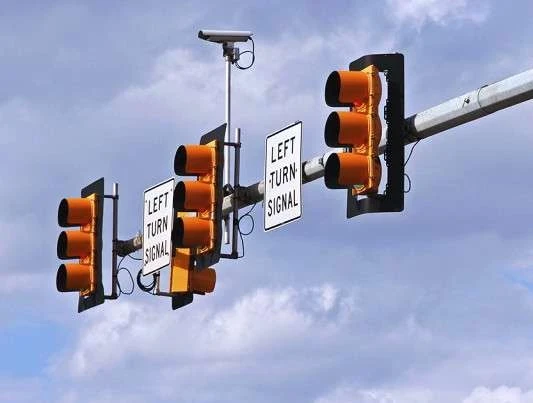
In Virginia, left-turn phase warrant analysis is performed using VDOT's Guidance for Determination and Documentation of Left-Turn Phasing Mode. Factors which establish the basis of left-turn phasing warrants include sight distance and related characteristics, number of left-turn lanes and intersection geometry, crossing distance/number of opposing lanes, intersection and receiving facility characteristics, critical crossing gap, correctable left-turn crashes, pedestrian considerations, and corridor consistency. A report is prepared to document the findings for each of the left-turn phase warrants including consideration of the impact of the phasing change on overall intersection operations including pedestrian and vehicular safety, as well as turn lane spillback/through lane blockage.
Yellow Change and All-Red
AMD Engineering understands that the calculation of yellow change and all-red clearance intervals has a significant impact on the frequency of red light running related crashes. Clearance and change intervals are calculated in accordance with the Signal Timing Manual, Second Edition (NCHRP Report 812) and guidance contained in NCHRP Report 731: Guidelines for Timing Yellow and All-Red Intervals at Signalized Intersections and when applicable, VDOT TE-306.1 (Yellow Change & Red Clearance Intervals). Factors to be considered in the calculations are field-verified and documented including approach speed, grades, intersection widths, and left-turn phasing type.
Design Services
- Traffic Signal Installation
- Traffic Signal Modification
- Temporary Traffic Signals
- Pedestrian Hybrid Beacons (PHB/HAWK)
- Rectangular Rapid Flashing Beacons (RRFB)
- Lane Use Control Signals
- Signal Timing Optimization
- Yellow Change and Red Clearance Interval Studies
- Pedestrian Crosswalk Facilities
- Accessible Pedestrian Signals (APS)
- Bicycle Signalization
Project History
- VDOT Richmond District On-Call: Fredericksburg-Area RRFB Crossings
- VDOT Richmond District On-Call: Caroline County Signal Replacement
- I-66 Outside the Beltway Design Services During Construction
- CBBT Parallel Thimble Shoal Tunnel*
- Capitol Crossing (I-395 Air Rights), Washington, DC*
- Virginia MegaProjects GEC*
- Route 123 at Route 1 Interchange*
- I-581/Valley View Diverging Diamond Interchange*
- DDOT New Jersey Avenue Two-Way Conversion*
- Fairfax County On-Call*
- Arlington County Multi-Modal On-Call (HAWK Signals)*
* Projects managed and/or designed by principals while at previous firms
Ready to start your project?
Contact Us